
For its study, ‘Rise of the Sustainable Southeast Asian (SEA) Traveller’, Blackbox Research surveyed more than 4,600 travellers across six Southeast Asian countries—Indonesia, Malaysia, Philippines, Singapore, Thailand, and Vietnam. The following content is part of this detailed study, which is aimed at understanding the rise of sustainable travel in SEA, while also taking a deep dive into each country’s trends.
With 54 ethnic groups, 30 national parks, 8 UNESCO sites––Vietnam’s rich landscapes and fascinating culture make it one of the top travel destinations of Southeast Asia. Amid the pandemic, while domestic travel helped keep the travel and tourism industry of Vietnam thriving, the industry still needs to reinvent and rebrand itself to recover the losses incurred during the shutdown.
For the rising community of mindful travellers, who like to take it slow, and give back along the way, Vietnam has myriad eco-friendly experiences to choose from. From hotels and resorts that believe in preserving the natural surroundings to eco-tours that support ethnic minorities, the country has a plethora of options for sustainable travellers.
The pent-up demand to travel freely in the post-pandemic phase without any COVID-19 restrictions has given rise to a phenomenon known as “revenge travel.” While capitalising on this trend, it could perhaps be the right opportunity to push for sustainable travel in the country as more people are looking to scratch their travel itch.
The following findings are aimed at helping sustainable travel and tourism organisations strategically position their products and services in Vietnam and help the pandemic-battered industry recover its losses.
Vietnamese are highly mindful of their travel choices
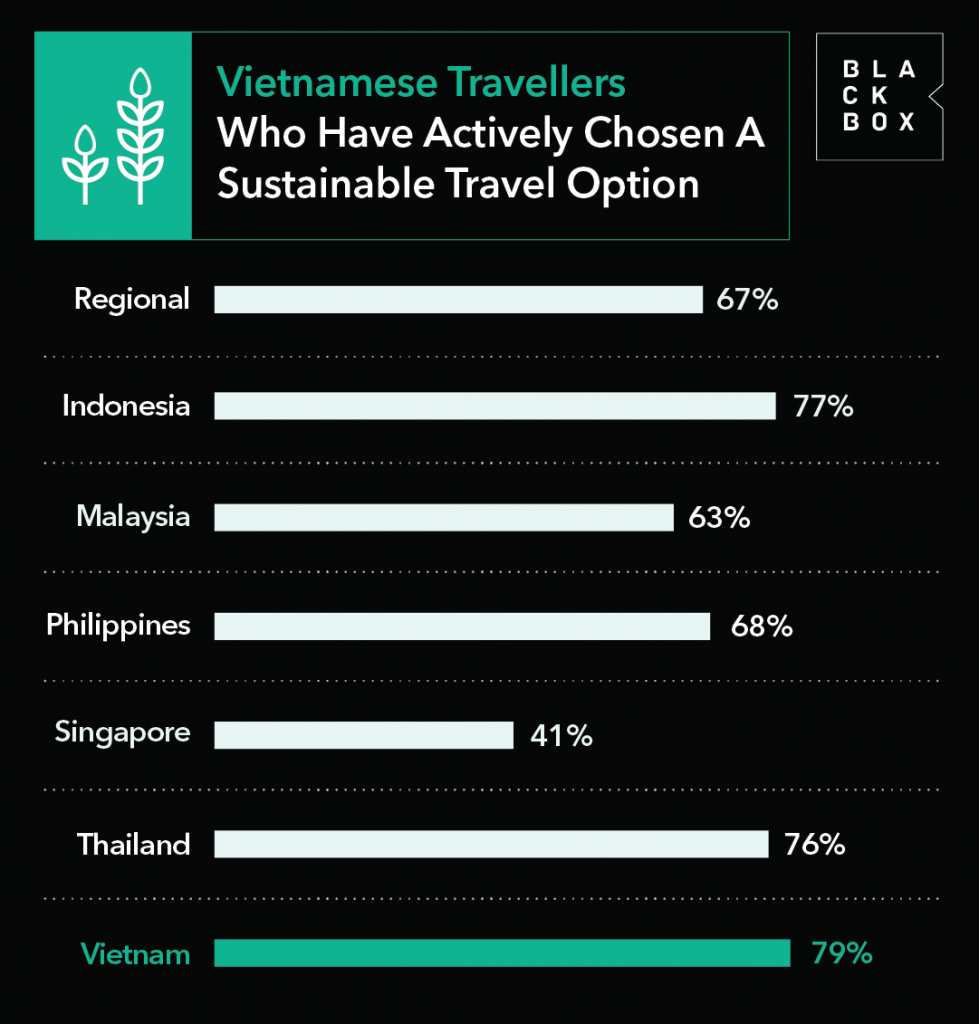
Scoring not only above the regional average but also topping the charts, Vietnam shows great potential for sustainable travel trends to thrive. Furthermore, the following priorities are useful to understand what travellers are thinking about when they choose a greener option:

Our survey highlights that 89% of Vietnamese believe in travelling responsibly and taking care not to harm the cultural and natural environment of a destination, so that they can be maintained long-term, and 88% prefer travel companies that are conscious of the urgency to make travel and tourism a more sustainable activity.
Factors giving rise to sustainability: Responsible behaviour, social validation
A deeper understanding of what motivates Vietnamese towards sustainable travel will also be helpful for planning such initiatives:

Our findings clearly highlight that Vietnamese are largely driven by both a sense of self-responsibility and selflessness, but many also seek the social validation that comes with choosing such sustainable options and sharing them with their friends. However, this could also be with the intent of simply sharing to promote more awareness. The data though also shows that at 23%, Vietnamese are quite unlikely to be persuaded by friends and family members, so simple validation may be a better explanation!
Lack of transparency, inadequate options: Key hindrances in making green travel choices
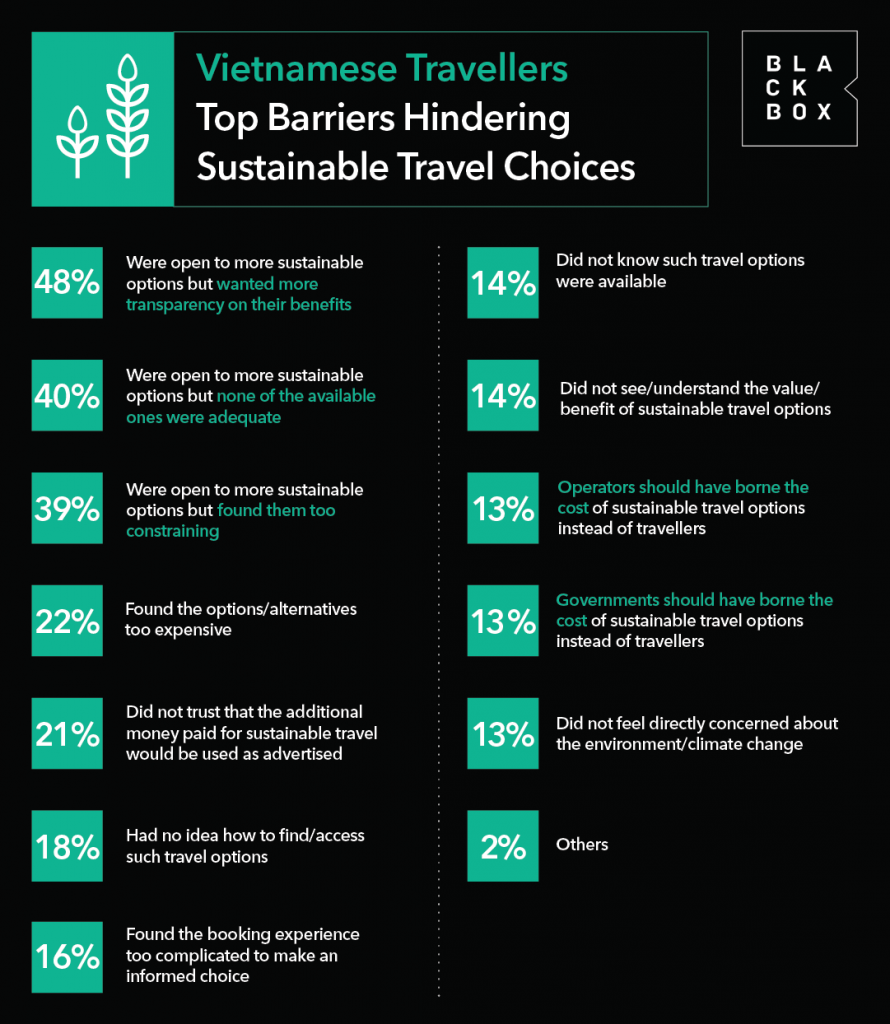
Transparency, adequacy, and sufficiency of sustainable options are the key barriers. Cost, for Vietnamese travellers, doesn’t appear to be a major factor and the previously highlighted finding of high self-responsibility is evident in the fact that only a small percentage of citizens feel that the government should bear the cost of sustainable travel instead of themselves. The other options occupying the lower ranks also suggest that Vietnamese are among the more aware travellers when it comes to choosing sustainable options.
Pushing domestic tourism helping Vietnam’s travel sector to recover
In 2020, the Ministry of Culture, Sports and Tourism and the Vietnam National Administration of Tourism launched a domestic tourism stimulation programme, “Vietnamese People Travel in Vietnam” to encourage domestic tourism and help people travel in the new normal context. It later launched another programme, “Vietnam tourism – a safe and attractive destination”, that further strengthened domestic tourism.
As per the Ministry of Culture, Sports and Tourism, domestic visits in February reached 9.6 million, a 380% increase compared to the same period in 2021, including about six million overnight stays.
In fact, Hanoi plans to organise a series of tourism events during the upcoming 31st Southeast Asian Games (SEA Games 31) to promote its image as a “safe and attractive destination” among domestic and international visitors. It could be an opportunity for the tourism industry to speed up the process of recovery.
Ever since the onset of the pandemic, Vietnam has been following a zero-case-first strategy, which led to higher levels of confidence among domestic travellers. As per this report, by implementing this approach and considering the country’s currently resilient local economy and government initiatives, there is a possibility that Vietnam’s tourism sector could recover to pre-COVID levels in 2024.
Do also check out our other country deep dives and regional overview article on the ‘Rise of the Sustainable Southeast Asian (SEA) Traveller’ study: Indonesia, Malaysia, Philippines, Singapore, Thailand, and Regional Overview.
For more data and insights from this survey, including country-specific breakdowns of results, please reach out to Blackbox Research at connect@blackbox.com.sg.
Author: Blackbox Research Team
Comments