
To learn more about the rising trend of sustainable travel in the post-pandemic era, Blackbox Research surveyed more than 4,600 travellers across six Southeast Asian countries—Indonesia, Malaysia, Philippines, Singapore, Thailand, and Vietnam. The following content is part of this research, ‘Rise of the Sustainable Southeast Asian (SEA) Traveller’, which is aimed at understanding how the trend is catching up in SEA, while also taking a deep dive into each country’s specific insights and trends.
With the climate crisis deepening, embracing sustainability in our everyday lives is no longer a choice, but the need of the hour. If there is one thing that the pandemic highlighted, it is that sustainability needs to be among the top post-pandemic agendas of the global economies. So where does Malaysia find itself amidst this trend?
Malaysians are gearing up to embrace sustainable travel

While the country hopes to revive its pandemic-battered industry during the upcoming holiday season, an important question arises—Is Malaysia ready to embrace responsible travel? While the optimism in Southeast Asia towards sustainable travel is high overall, with a regional average of 67% (people who have chosen a sustainable travel option), only 63% of Malaysians are willing to choose such an option as compared to Vietnamese, Indonesians, Thais, and Filipinos; Malaysians are only ahead of Singaporeans.
However, there are other interesting insights from our study that reveal that Malaysians are fast catching up on the trend of sustainability. As per our study, 82% of Malaysians feel it is essential to opt for environment-friendly modes of transportation to minimise carbon emissions, and nearly 9 in 10 (87%) believe in making conscious efforts to preserve the cultural and natural environment of a destination so that they can be maintained long-term. Likewise, 82% of Malaysians prefer to visit cities/countries that put the conservation of fauna and flora at the heart of their tourism agendas.
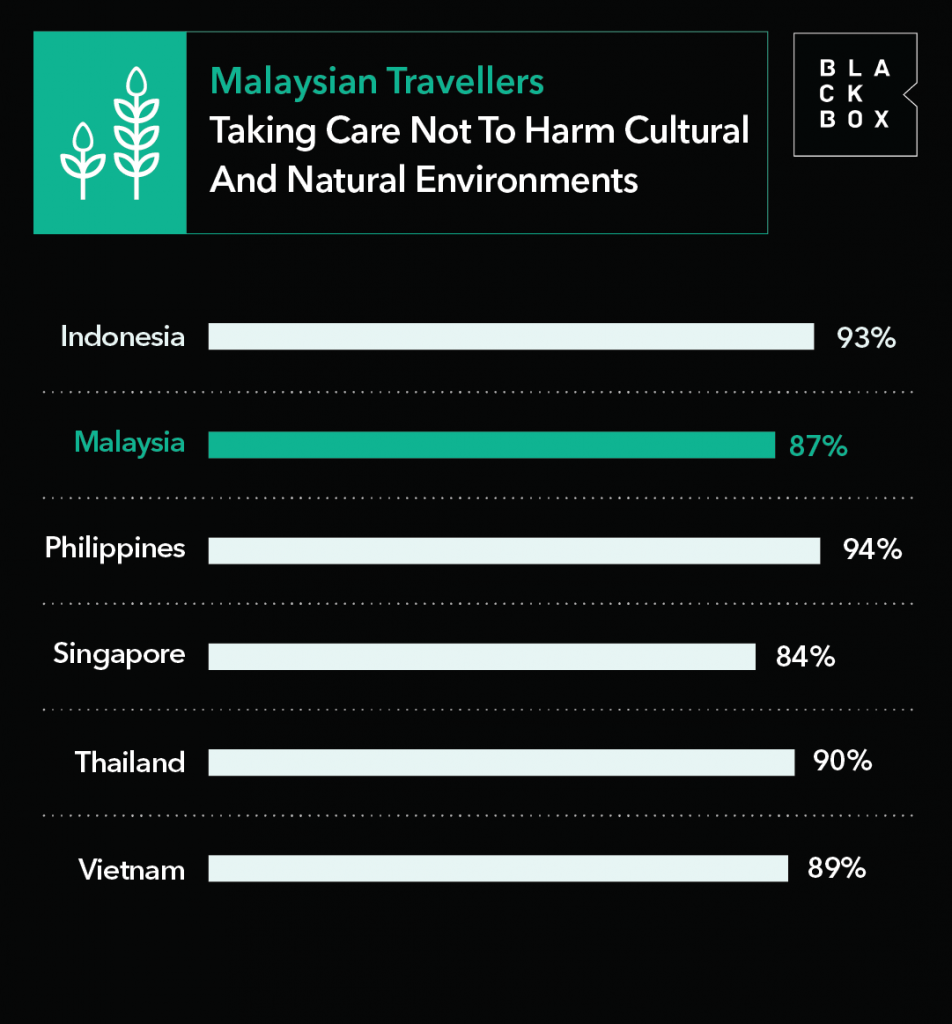
These findings from our study reveal that there is definitely a certain level of environmental awareness among Malaysians, which can be helpful in mitigating the effects of climate change. Now, with the country reopening and restrictions being eased, it may be the perfect time to address environmental concerns and encourage more travellers to adopt sustainable practices, and for tourism industry players to re-strategise their marketing tactics by incorporating greener offerings in their packages.
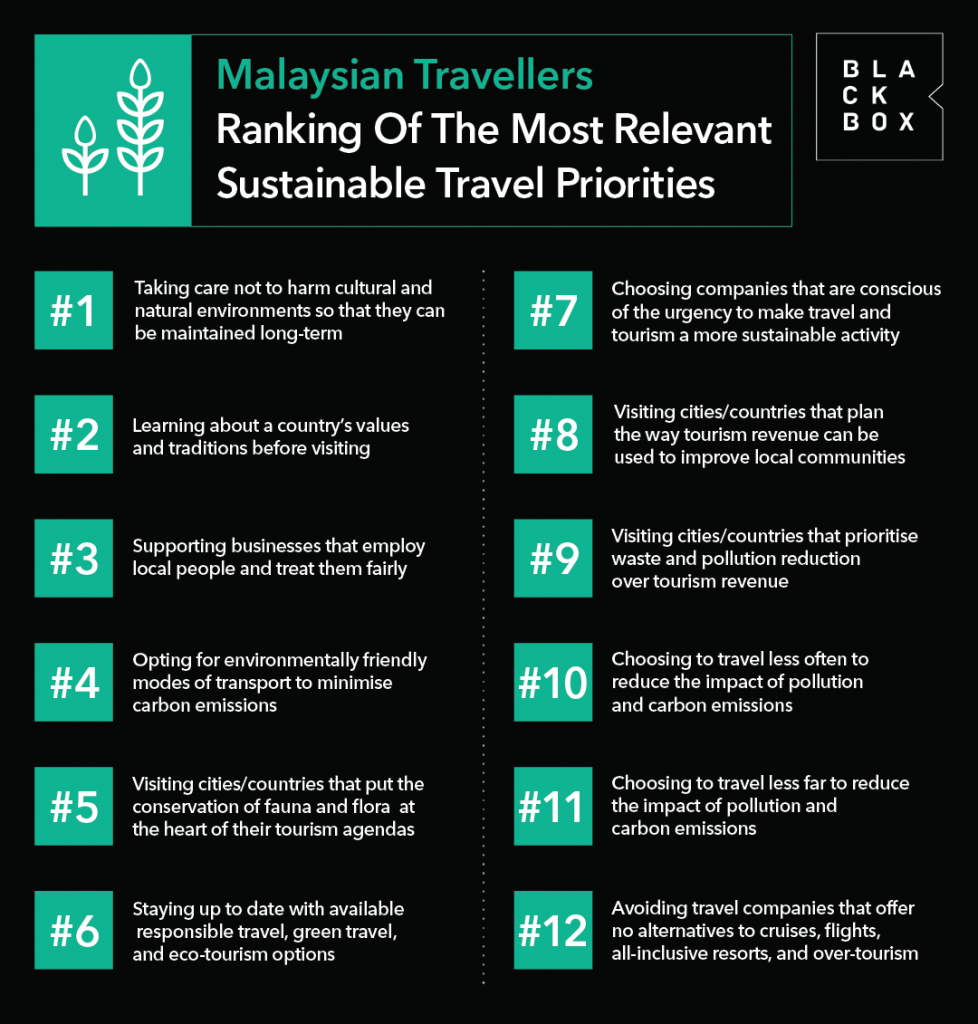
Here’s an overview of Malaysians’ priorities when it comes to travelling sustainably:
Malaysians want strict laws and regulations to preserve natural sites
85% of Malaysians feel there is an urgent need to strengthen laws and regulations aimed at preserving/protecting natural sites/areas. The eco-consciousness of Malaysians is also reflected in the fact that 84% would like to support smaller, eco-friendlier hospitality options while on a holiday, and 83% suggest taking strict/harsh action against travel and tourism operators who put local communities/eco-systems in harm’s way. These findings are essential for the stakeholders in the travel and tourism sector who can help in tackling the impacts of climate change and assist in the strict enforcement of rules and regulations to preserve the enormous biological and cultural diversity of the region.
What keeps Malaysians from making responsible choices while travelling?

Our survey highlights that Malaysians are unaware of the availability of sustainable travel options, and 41% have no idea how to find/access them. There is also a trust deficit in relation to travel providers among Malaysian travellers, which is clear from the finding that 30% do not trust the fact that the additional charges for choosing a sustainable option would be used as advertised. Furthermore, 22% of respondents don’t see any point in why travellers should bear the cost of more sustainable options (operators should) and the same number of respondents found sustainable options quite constraining.

These findings are particularly important for travel companies and tour operators, who can help consumers build more sustainable travel habits right from the moment they search and book a trip and suggest ways to reduce the environmental impact that the travellers make during their vacations.

More groundwork is needed to push for sustainable tourism in Malaysia
One of the key transformation strategies of theNational Tourism Policy 2020-2030 Malaysia is to push for sustainable and responsible tourism. In alignment with the United Nations Sustainable Development Goals (UNSDGs), the policy aims to “reinforce the role of tourism as a catalyst for economic development in a sustainable, responsible and inclusive manner”.
Apart from this, one of the key themes of the Twelfth Malaysia Plan, 2021-2025 is advancing sustainability. It aims to push for “a nationwide shift to more sustainable economic practices and lifestyles that value natural endowments and environmental health”. This shift will address the issues of “climate change, unsustainable consumption and production practices, loss of biodiversity, lack of coherence in the implementation of policies and inefficient water resources management”.
While the country’s National Ecotourism Plan 2016-2025 aims at developing “cluster-based ecotourism destinations with special concession packages that inculcate the use of technology and smart eco-management of destinations”, there is a need for advanced ground efforts to ensure that responsible tourism lies at the heart of the strategies and plans of the major stakeholders in the country’s economy.
Sustainable travel opportunities for the future
In the near future, new sustainable travel opportunities may lie in promoting activities that tap into the stunning wildlife, rich fauna and flora, ethnic tribes, and picturesque landscapes of Malaysia. The country can look at promoting eco-friendly trips to its orangutan sanctuaries and rehabilitation centres or urging more local resorts to adopt green practices to effectively reduce, reuse, recycle and promote activities that support local communities. From shopping at a mall to dining out to staying in a hotel while travelling, almost everything you do on a vacation can include a sustainable element.
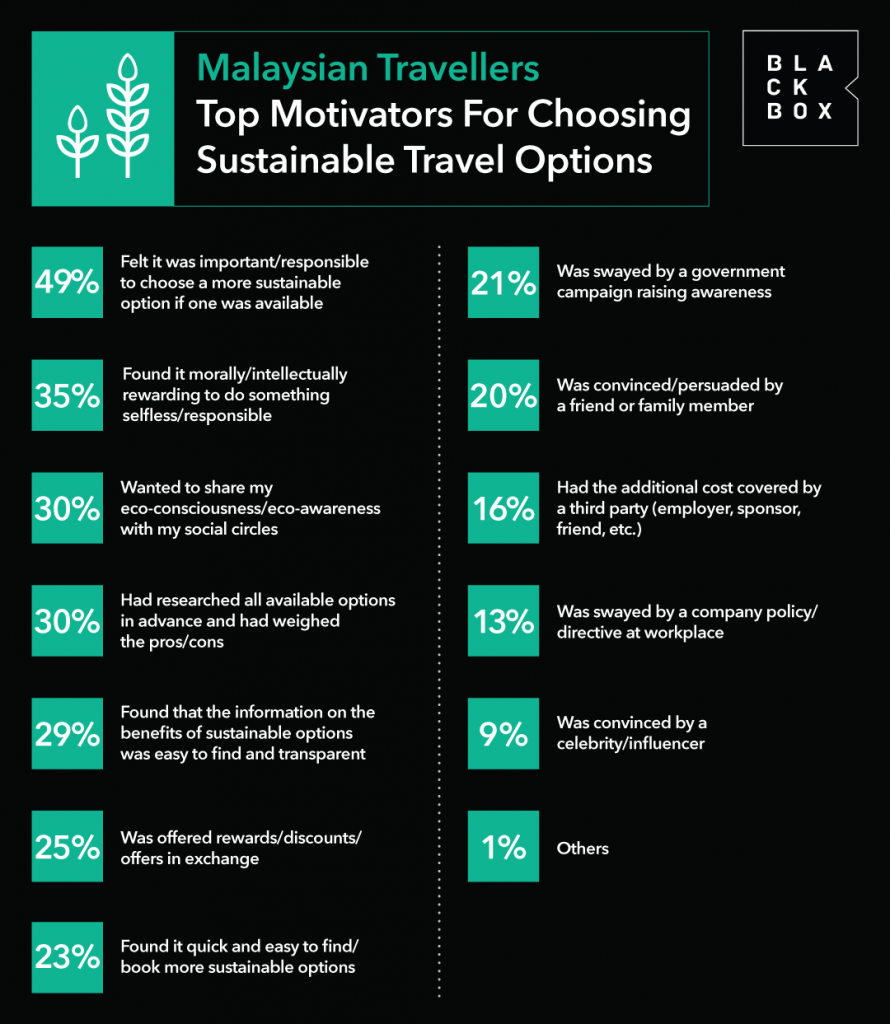
An understanding of what motivates Malaysians towards sustainable travel will also be helpful for planning such initiatives.
Going green: A must for Malaysia
While Malaysia is one of the most biodiverse countries, the country is grappling with the degradation of ecosystems, both in its wetland and its dense forests. Globally, the world may face unavoidable multiple climate hazards over the next two decades with global warming of 1.5°C (2.7°F), as per IPCC’s 2022 report on climate change.
With growing urbanisation in the country and climate change issues rising globally, the need to adopt sustainable practices is imperative to deal with the cascading impacts and secure a liveable future.
Do also check out our other country deep dives and regional overview article on the ‘Rise of the Sustainable Southeast Asian (SEA) Traveller’ study: Indonesia, Philippines, Singapore, Thailand, Vietnam, and Regional Overview.
For more data and insights from this survey, including country-specific breakdowns of results, please reach out to Blackbox Research at connect@blackbox.com.sg.
Author: Blackbox Research Team
Comments