
Blackbox Research surveyed more than 4,600 travellers across six Southeast Asian countries—Indonesia, Malaysia, Philippines, Singapore, Thailand, and Vietnam—to understand the green potential of the region. The following content is part of this research, ‘Rise of the Sustainable Southeast Asian (SEA) Traveller’, which is aimed at understanding the post-pandemic sustainable travel choices, top motivators, top barriers, and how the trend is catching up in SEA, while also taking a deep dive into each country’s specific insights and trends.
After two years of a travel slump, the Philippines is gradually moving towards becoming an ideal global tourist destination. Comprising 7,641 islands in the western Pacific Ocean, the country is now repositioning itself as a top travel spot. To gear up for the post-pandemic recovery, the country is committed to supporting global climate change mitigation efforts by promoting green tourism.
The following findings from our study are aimed at helping sustainable travel and tourism organisations strategically position their products and services in the Philippines.
Filipinos are committed to sustainability and want concrete action
Our survey reveals that 94% of Filipinos support smaller, eco-friendlier hospitality options. The same percentage of respondents are in favour of using the revenue generated via tourism to be utilised in developing nature conservation projects. Likewise, 94% of respondents want to strengthen laws and regulations aimed at preserving/protecting natural sites. This shows that there is not just environmental awareness, but a determination among Filipinos to take concrete steps to preserve nature.

A quick look at some of the top priorities of Filipinos when it comes to travelling sustainably:

Social validation and responsible attitude: Top motivators to go green
While trying to understand people’s attitudes towards the environment and sustainability, our survey revealed some of the key motivators that help people make responsible travel choices in the Philippines. Awareness and willingness to make greener choices is evident from the fact that 50% of Filipinos felt it was important/responsible to choose a more sustainable option if one was available.
Other key takeaways from our survey include:

Lack of access, high costs: Key hindrances in making green travel choices
While a majority of Filipinos are mindful of their travel choices, our survey reveals that there are a few hindrances, too, that keep travellers from embracing sustainability. Despite their willingness to act on awareness of sustainable travel options, a significant number of respondents (50%) said they had no idea how to find/access such travel options, and 46% said they did not know such travel options were available in the first place.
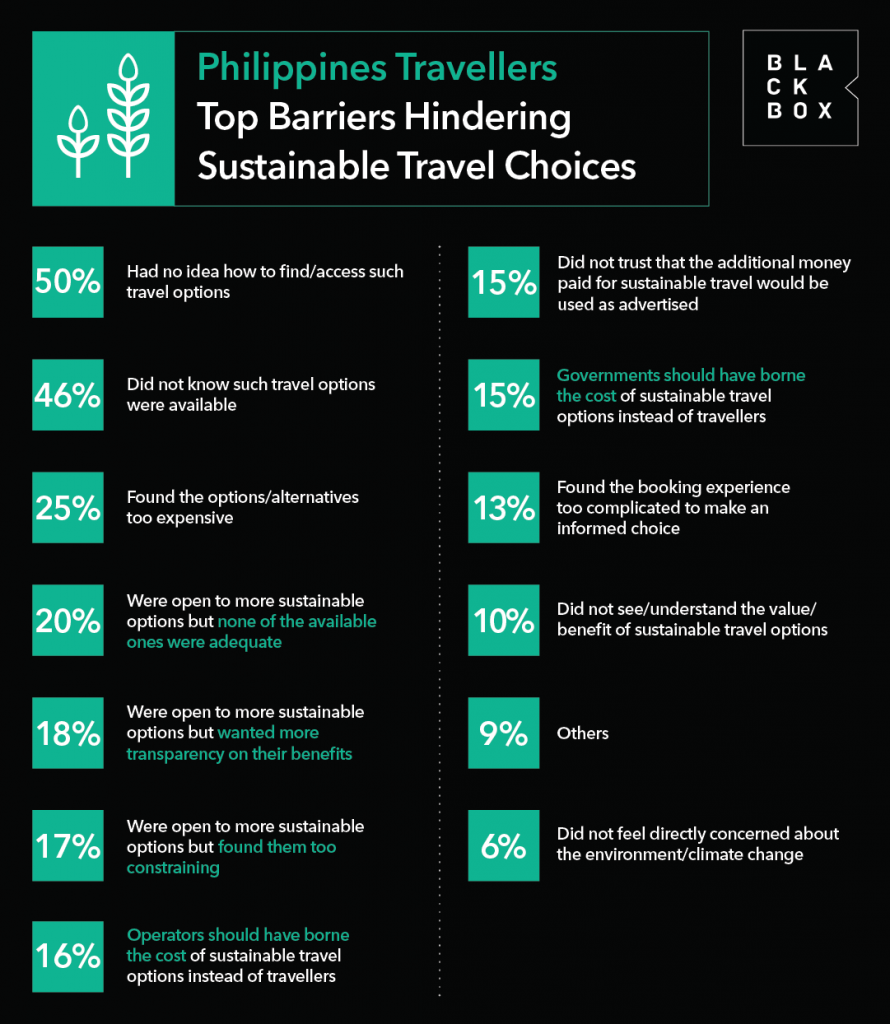
A closer look at other key hindrances:
These findings can be of good use to tour operators, who should look at not just spreading awareness about the greener travel options but can offer specific trips with the goal of being environmentally sustainable, for example, beach clean-ups, or encouraging hiking/biking trips that employ eco-friendly modes of transport to explore the locales. The tourist operators should also ensure that right from searching to booking greener travel options, the whole experience is simple, transparent, and clearly states the pros and cons of sustainable travelling. This will hopefully encourage more travellers to make an informed choice.
Road to recovery for the tourism sector
The Philippines recently hosted the 21st Global Summit of the World Travel and Tourism Council (WTTC), with the aim “to maximise the inclusive and sustainable growth potential of the travel and tourism sector by partnering with governments, destinations, communities, and other stakeholders to drive economic development, create jobs, reduce poverty, security and understanding in the world”. The summit, which gathered world leaders of the tourism industry, aims to align efforts to “revive the tourism sector and transition to a safe, resilient and sustainable future”.
Emphasising the need for sustainable tourism, Tourism Secretary Berna Romulo-Puyat, said the summit also gave way to “passionate advocates for responsible tourism, and for a greener environment.” “Our destinations must not be allowed to go back to the old unsustainable ways of the past. Instead, we must move forward guided by strategic and evidence-based planning and aimed towards building further resilience,” she added.
With several Filipinos looking forward to travelling in the coming months, it is essential that travel operators take the opportunity to highlight the concrete benefits of their sustainable offerings. This will possibly push more travellers to turn their growing eco-consciousness into informed decisions as well as impactful choices.
Do also check out our other country deep dives and regional overview article on the ‘Rise of the Sustainable Southeast Asian (SEA) Traveller’ study: Indonesia, Malaysia, Singapore, Thailand, Vietnam, and Regional Overview.
For more data and insights from this survey, including country-specific breakdowns of results, please reach out to Blackbox Research at connect@blackbox.com.sg.
Author: Blackbox Research Team
Comments