
The acronym STEM was coined to highlight the most critical skills required to succeed in the workplace. It encompassed Science, Technology, Engineering and Mathematics. Collectively, these are referred to as hard skills that are required to be eligible for lucrative jobs. Such competencies have stood the test of time, and even today, the most high-paying jobs broadly come under this umbrella. However, an often-ignored component is the soft skills required to succeed in one’s field as one begins to climb the ladder.
That’s where an arts education comes in. By integrating this into STEM, the journey to STEAM is complete, arming graduates with both hard and soft skills to be the leaders of tomorrow. Such arts-based skills include critical thinking, creativity, collaboration, self-confidence, ethics—among others.

Awareness of STEAM is lacking among those for who it matters the most
In a recent study conducted in collaboration between United Women Singapore and Blackbox Research, which interviewed 400 female students and 124 hiring managers, it was found that students overall had lower awareness of STEAM (in comparison to STEM), and 30% did not see how including an arts component in their STEM education will benefit them.
Moreover, on a self-rating scale, most students rated themselves low on 21st Century Competencies (21CC), which are considered the core competencies that hold one in good stead when it comes to surviving and thriving in a dynamic work environment. These competencies broadly include civic literacy, digital literacy, global awareness and cross-cultural skills, critical and inventive thinking and communication, collaboration, negotiation, and information skills.
Furthermore, it is telling that the hiring managers interviewed in our study feel that students lack 3 out of the 4 important 21CC that they are looking for, namely problem solving, critical thinking, and communication.
Where does Singapore stand on this journey?
Singapore’s successful approach to STEM is for the world to see, and it’s been so for a while now. A BBC report highlighted that “Singapore has the highest-achieving primary and secondary pupils in international education tests in maths and science.” The STEM approach is so emphasised in the island city that even PM Lee Hsien Loong said in 2015 at the official opening of the Singapore University of Technology and Design (SUTD) that these skills must be strengthened to take Singapore ahead in the next 50 years. He remarked, “Building greener homes, connecting our waterways and parks, expanding our public transport networks, embarking on complex projects, all these require expertise and skills in engineering, technology, and design.”
So while the foundation stone has been set, if the arts component is further integrated into the system at a greater level than it currently is, the rewards will be well worth it as the country heads into post-pandemic future that calls for both sustainability and sensitivity.
What are the gaps in the current curriculum and where do the opportunities lie?
Over 9 in 10 hiring managers are looking for candidates with skills such as problem-solving, communication, collaboration, adaptability, and critical thinking. However, half of the students feel that their current curriculum is not equipping them with these skills. Among the other skills needed, students also feel that negotiation and customer orientation are ‘least emphasised’.
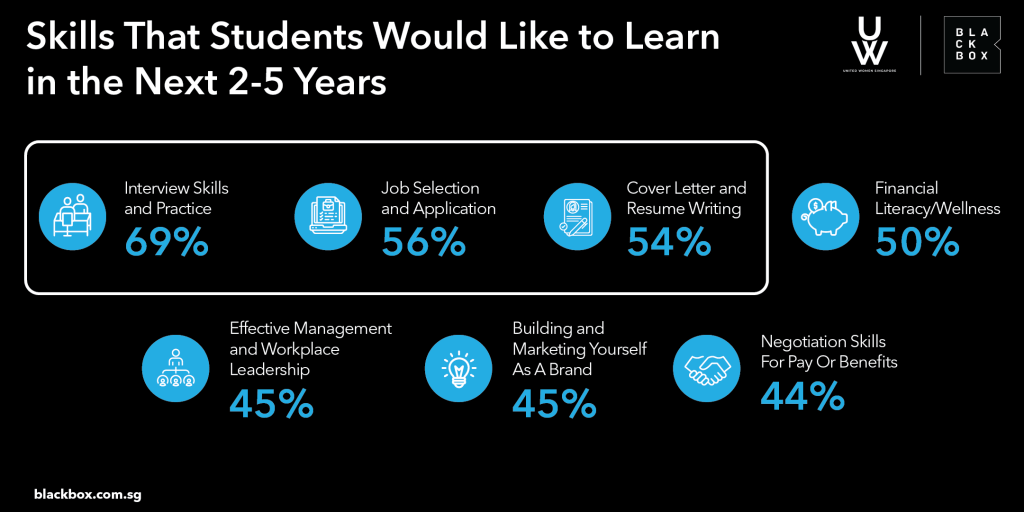
When asked about the skillset that they’d like to build on in the next two to five years, 69% selected ‘interview skills and practice’, 56% opted for ‘job selection and application’, and 54% highlighted the need to be trained in ‘cover letter and resume writing’.
A future workforce that is competent and conscientious
Evidently, building awareness around the importance of arts is step one. This can be done through greater advocacy around it by ed-tech companies offering such training programmes. Ultimately though, a push from the government will help set the tone so more schools and colleges will sit up and take notice. When integrated into the system as a matter of policy, it will be easier to promote and highlight it.
Other ways include creating opportunities for students to interact with industry professionals and practice these skills (21CC) through internships, job shadowing, and job attachment opportunities. Importantly, the best kind of training begins at home and parents, by being open to honing such skills, can play a crucial role by giving a holistic direction to their children through encouragement, support, and guidance.
STEM-related jobs will always be much sought after. A recent study by Blackbox Research showed that the enthusiasm for working at tech start-ups, in particular, is high. While these may be dream jobs for many, the reality of the tech world also includes the possible burnout syndrome and its toll on mental health, routine layoffs, and uncertainty when it comes to job security. This means that there is a need to have professionals who are not only competent in the skills that are required to do their jobs but also to be resilient in the face of adversity while being confident and self-assured in their abilities. An arts-based education may help with just that.

To discover how Blackbox Research can help you be attuned to the latest insights in the education space and assist in building the workforce of tomorrow, reach out to us at connect@blackbox.com.sg
Author: Blackbox Research Team
Comments