
Quiet Quitting.
A quick glance at this term might make you believe it is a witty phrase that reflects the cleverness of employees getting away with slacking off when they are not supposed to. Well, far from it.
Quiet Quitting as a phenomenon isn’t new. We just have a name for it now, although a singular, universally agreed upon definition still doesn’t exist. Rather, quiet quitting encompasses a wide range of interpretations such as doing the required minimum amount of work, declining additional work/responsibilities without financial compensation, or being vocal in work meetings (not afraid of speaking up). It seems that quiet quitting as a phenomenon has already been happening around the world for quite some time, but awareness of the terminology itself is still in its nascent stages. For example, more than half of the respondents surveyed in the US had not even heard of the term.

As for definitions, a YourDictionary.com one sums it up well: “Quiet quitting refers to not overworking yourself or doing extra things that you won’t get compensated for; you’re not an underachiever but also not an overachiever. It’s doing the tasks involved with your assigned role, no more, no less. Simply put, it’s doing your job without your job taking over your entire life.”
Quiet Quitting is often seen as a younger workforce issue, and this is mostly due to the publicization of quiet quitting on social media platforms such as TikTok and Instagram stories. There is also a misconception that younger employees are just being lazy or entitled workers.
However, quiet quitting is neither a new nor a young person issue, and it spreads across demographics. For example, as per a Gallup survey, at least 50% of the American workforce comprises of “quiet quitters”! On a related note, the “actual quitters” are in staggering numbers too. In February 2022, close to 4.4 million Americans quit their jobs, and an additional 4.53 million workers left their jobs in the following month.

Quiet Firing: A passive-aggressive approach by employers
On the flip side, quiet firing has also taken hold within many offices around the world. Another misnomer, quiet firing refers to a set of activities that make working conditions miserable for employees. Popular job portal LinkedIn defines it succinctly: “The phenomenon is described as the act of intentionally treating workers badly so that they eventually leave their jobs.”
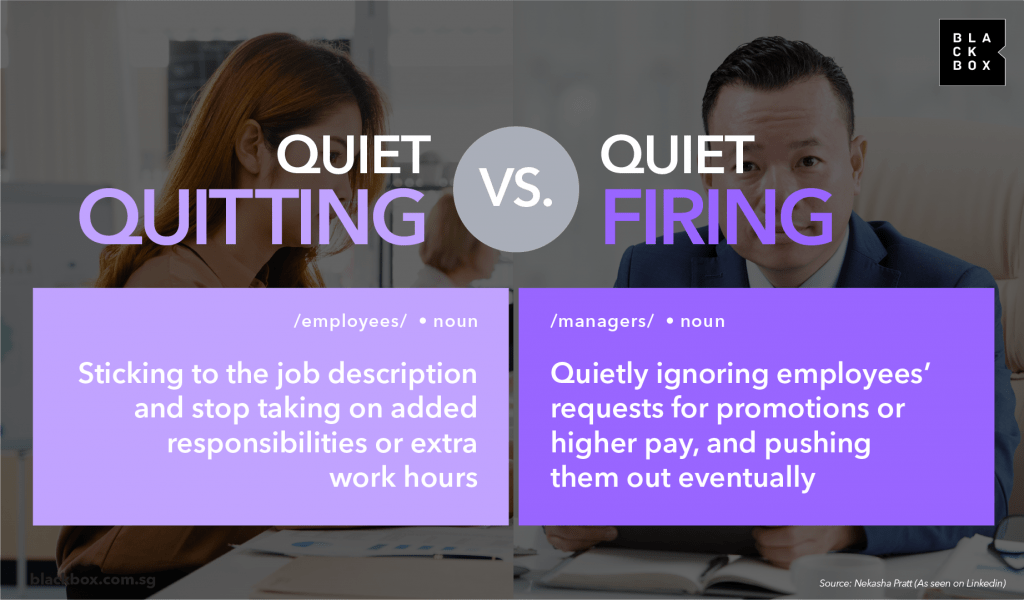
Famously, stories of Japanese employers sending their unwanted employees to banishment rooms to do mundane, almost mind-numbing tasks to induce a resignation is a form of quiet firing. Some Singaporeans who have been “quiet-fired” have shared experiences of being denied raises for years on end, being blocked from opportunities for growth or promotion, or feeling neglected by not receiving direct and timely feedback. Excessive criticism, long emails detailing poor performance, and reduced in-person communication are generally considered signs of quiet firing an employee.
This is often done to force employees to quit themselves and save companies from paying out potential severance or other end of employment benefits (e.g., gratuity). Quiet firing is also seen by some HR managers as a way of managing out underperforming employees though some have called the practice as an excuse for a toxic work culture.
Changing Relationships between Employers and Employees
Both quiet quitting and quiet firing are reflective of the changing expectations that employees and employers have of each other and is now becoming a part of mainstream discussions.
Closer to home, employers in Singapore, especially bosses from small and medium enterprises (SMEs), have been heavily criticised online for being overly “extractive” of their employees such as setting unrealistic expectations and even gaslighting employees by punishing good performances with additional workload instead of rewards.
Employees’ desire for growth and personal development is an important factor to consider. For example, start-ups have become popular among younger Singaporeans, in part due to the potential avenues for professional growth and development. Younger employees look to their employers as mentors, providing important career lessons in addition to just monthly salaries.
Labour theory can help HR and talent managers understand the employer-employee relationships and how such relationships affect the well-being of both parties. Certain ‘toxic’ controls exerted by employers onto employees often create a sense of powerlessness, questions over self-worth, and leave employees isolated from employers’ business goals. What this means in layman terms is that due to the differing power dynamics between employers and employees, the latter feel powerless to create a healthier working environment for themselves while employers easily fall into the trap of being extractive of their employees, intentionally or otherwise.
Part of the changing dynamics and tensions between employers and employees is also rooted in generational gaps. Employers, likely to be of the older demographic, believe that employees should always go above and beyond in the workplace. Whereas younger employees are generally within the “do the work they are paid for – no more, no less” camp. Hence, it is evident that there are differing expectations of what employees should do at the workplace.


Mental health has become an important aspect of employees’ lives and a main motivating factor behind the quiet quitting phenomenon. Post COVID-19 lockdowns, employees globally have notably yearned – and strived – for a healthier work-life balance. In Singapore alone, well over half (56%) of younger Singaporeans (aged below 35) would quit their jobs if their work interfered with their ability to “enjoy life”. Additionally, 40% of Gen Z respondents would be okay with not having a job rather than working in one they don’t like. Other countries have also seen the rise of similar sentiments.
Moving from “Extractive” to “Constructive” Employer-Employee Relations
For employers and managers, the growing push for quiet quitting should raise concerns about the well-being of their employees. In organisations rife with quiet quitting and quiet firing practices, upfront conversations about workplace-related stress need to be undertaken as work-related stress can pose a significant health and safety issue. A stressed-out employee is also more at risk of reduced productivity and increased levels of absenteeism (both physically and mentally).
For employees, challenging the status quo of an extractive employer-employee relationship can be daunting. And while it is easy to pin all blame on employers and paint them as villains, employees should also take some responsibility in ensuring that fair working conditions are present at their workplaces. Employees should make concerted efforts to raise genuine concerns to their employers and offer fair solutions that benefit both parties. Afterall, a business is ultimately contingent on the collaboration and cooperation between employers and employees.
As for HR managers and professional talent developers, teaching management and communication skills to both employers and employees is imperative. Many employee grievances can be resolved easily if only they are communicated early and addressed effectively. Employers could also use lessons in managing employees, especially younger ones who might not buy into age-old beliefs about the power dynamics between employers and employees. For instance, many young Singaporeans do not buy into the “we are family” or “young Singaporeans are not hungry enough” rhetoric that some SME bosses use to gaslight employees.
Employer-employee relations have changed and have real consequences on business performance and outlook. Get in touch with us at connect@blackbox.com.sg to understand how employers, employees, and talent managers can co-create a healthier working environment for all.
Author: Blackbox Research Team
Comments