
Image credit: South China Morning Post (SCMP)
As the world makes giant strides towards inclusivity and diversity in all spheres of life, there are some colonial-era laws that have no modern-day relevance but continue to polarise society.
Singapore, like many countries around the world, has one of its own such touchy topics—in the form of Section 377a. However, the debate can now be firmly put to rest with PM Lee Hsien Loong announcing at the National Day Rally (NDR) 2022 that Singapore will repeal Section 377a.
What is Section 377a?
While this law technically makes intercourse between consenting male adults a criminal offence, it is rarely enforced to prosecute anyone. For the longest time, despite the debates and countless petitions, there was hesitancy to strike it off completely though, as the government attempted to tread a fine line between traditional sentiments and modern viewpoints. That was likely the reason for the past judgment that ruled in favour of the law staying on the books but being “unenforceable in its entirety”. With concerns for misuse still persisting however, the next logical step was a complete repeal.
A history lesson
The irony isn’t lost on anyone. The original creator of this law, United Kingdom, itself repealed it way back in 1967. India, too, despite being a traditional society, struck it down in a landmark judgement dated 2018. A judge who was part of the bench went on to say, “History owes the LGBT community an apology for their sufferings.” This was in reference to the constant abuse that the community has endured around the world. So, while there is much to cheer about in terms of the law not being enforced, the demand for its abolishment in Singapore isn’t without merit. A possible reason for this could be fear since it is, in the strict legal sense, a criminal offence as long as it remains a part of the law. Among other Asian countries, China decriminalised homosexuality in 1997, but Pakistan and Bangladesh still have not. In Southeast Asia specifically, Malaysia and Myanmar too have retained this law while Thailand, Laos, Cambodia, Vietnam, Indonesia (except Aceh that enforces Sharia Law), and The Philippines do not criminalise it. However, discrimination against the community continues to exist. With Singapore recently deciding to repeal it, the LGBTQI community, along with activists, citizens and certain lawmakers have reason to celebrate their victory in a hard fought battle.
Striking a balance
The Singapore government has spoken in support of the community, even though the words chosen have been nuanced in order to not upset the applecart. Home Affairs Minister K. Shanmugam was quite candid in his concerns, when he said, “If and when we decide to move, we will do so in a way that continues to balance these different viewpoints, and avoids causing a sudden, destabilising change in social norms and public expectations.” He also added, “We seek to be an inclusive society, where mutual respect and tolerance for different views and practices are paramount.” He continues to endorse Prime Minister Lee Hsien Loong’s remarks in 2007 on the issue, when the latter expressed his desire for Singapore to be “a stable society with traditional heterosexual family values, but with space for homosexuals to live their lives and to contribute to society”. The PM further emphasised, “Among them are some of our friends, our relatives, our colleagues, our brothers and sisters, or some of our children… our kith and kin.” Even with the recent decision of repealing Section 377a, the Singapore Government was careful to amend the constitution to protect the definition of marriage as one between a man and woman. This was done in order to avoid any possible legal challenges while at the same time being mindful of traditional societal norms.
Public perspectives
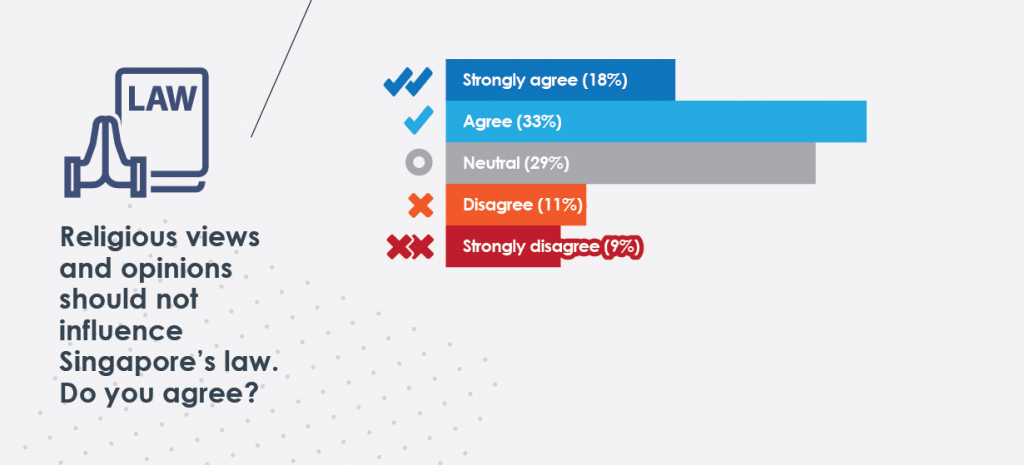
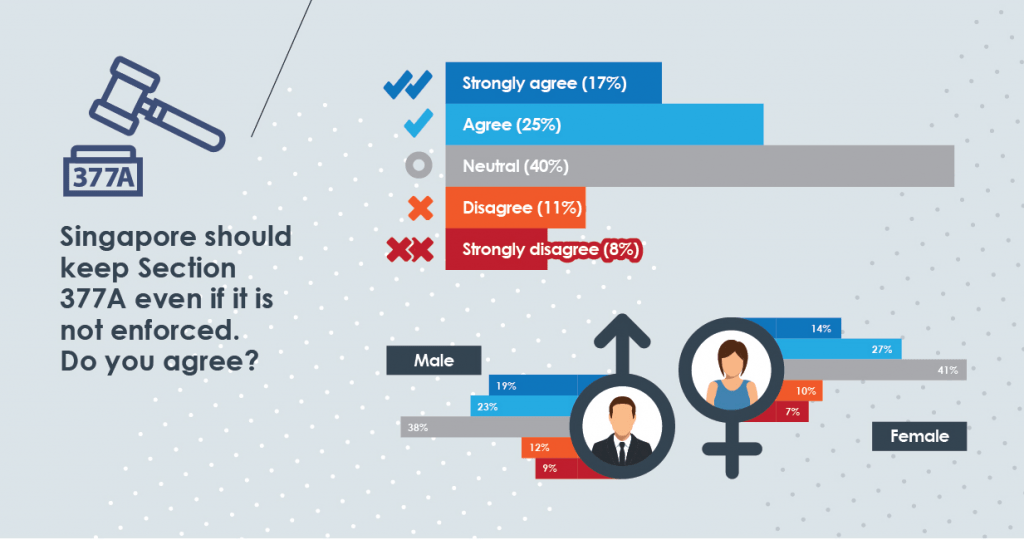
A survey by Blackbox Research, commissioned by Yahoo News Singapore in 2018, asked a few questions to 1,000 respondents that highlighted some interesting talking points.
Question 1: Repealing Section 377A would lead to a breakdown of the family unit in Singapore.
Do you agree?

Question 2: Religious views and opinions should not influence Singapore’s law. Do you agree?
Question 3: Singapore should keep Section 377A even if it is not enforced. Do you agree?
Question 4: Singapore does not criminalise sex between women. Some say, the absence of such a law is harmful to society. Do you agree?

It is worth noting that the proportion of younger people who disagreed with statements 1, 3 and 4 and agreed with statement 2 were significantly higher, indicating a difference in perception among generations. Moreover, the religious angle here is a contentious one since while citizens are predominantly against or neutral about the intervention of religion in laws, religious bodies such as the National Council of Churches, Singapore Islamic Scholars and Religious Teachers Association (Pergas), and the Roman Catholic Archdiocese of Singapore are asking to authorities to retain the law in order to safeguard the traditional family unit.
Concluding thoughts
Section 377a while put to rest with the recent repeal is still likely to continue being a hotly debated topic when it comes to conservative societies in general. Given the sensitivities involved, it is understandable why there are strong opinions on either side of the debate. However, everyone is likely to agree that a truly stable society is an inclusive one, and this is a step in the right direction. Meanwhile, the LGBTQI community can take solace in the fact that with the official striking down of the law, it won’t even be on paper anymore.
Singapore is home to over 5 million people. The city-state is a cosmopolitan environment awash with a variety of cultures, beliefs and opinions. People have a right to their beliefs, but it should not compromise the well-being of others. Repealing a law that has been divisive in recent years and serves no purpose is an important step. It is hoped that Singapore can now move on and continue building an inclusive society for all.
Author: Blackbox Research Team
Comments